Discover the detailed program for "The Essence of Feng Shui"
A course in Traditional Feng Shui, enriched by modern practices, offering a comprehensive and contemporary approach to harmonising spaces
MODULE 1
Mastering the Energy Principles of Feng Shui
Understanding energy flows within a home’s environment
Duration : 10 hours – Limited places
THE PROGRAM
Part 1 : History and Philosophy of Feng Shui
Part 2 : The concept of the 3 powers
Part 3 : The concept of Qi (Chi)
Part 4 : The Concept of Yin and Yang
Part 5 : The Concept of the Five Elements
Part 6 : The Three Cycles
Part 7 : The Bagua and the Environment
THE OBJECTIVES
To understand the key concepts of Feng Shui (Qi, Yin-Yang, the Five Elements, etc.) and know how to use them as frameworks for analysing an interior environment, whether at the design stage or during adjustments.
Observe the flow of Qi, identify the main energy imbalances and formulate recommendations for harmonisation aimed at improving the flow, balance and overall comfort of the space.
Select and position shapes, colours and materials in accordance with the principles of Feng Shui in order to structure and optimise a space in a balanced and functional way.
MODULE 2
Connecting people with their living environment
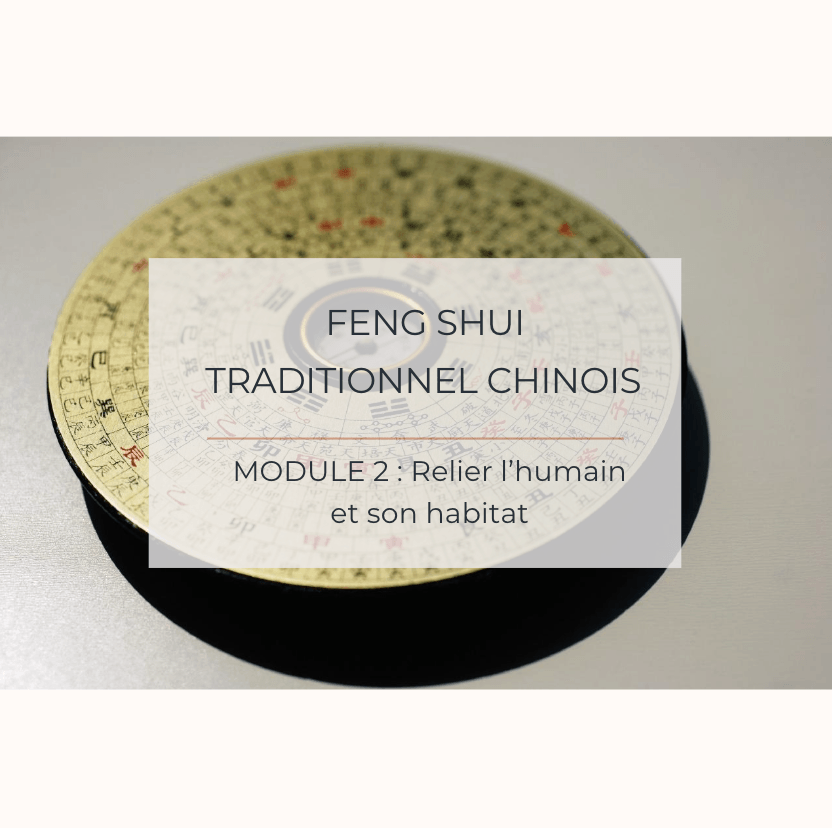
Understanding the influence of the Earth’s and humanity’s energies
Duration : 20 hours – Limited places
THE PROGRAM
Part 1 : Bagua and the individual, the Ming Gua
Part 2 : The psychology of the home and the individual in biophilic design
Part 3 : The concept of façade and foundation
Part 4 : Taking measurements and determining orientations
Part 5 : Sectorisation (black holes, etc.)
Part 6 : Bazhai and the 24 Mountains
Part 7 : The basics of Bazi (Chinese astrology)
THE OBJECTIVES
Identify a person’s key energy characteristics (Ming Gua, the basics of BaZi) and understand how they interact with their living or working environments.
Learn how to use the Feng Shui compass to determine the orientations of a space, define the sectors and interpret the basic data required for an initial energy analysis.
Observe how the layout, history and atmosphere of a space can influence the feelings, well-being and certain personal dynamics of its occupants.
MODULE 3
Creating spaces that harmonise with nature
Understanding the influence of energies from our natural and man-made environments
Duration : 20 hours – Limited places
THE PROGRAM
Part 1 : The 6 Circles of Influence
Part 2 : Analysis of the External Environment
Part 3 : Form, architecture, positioning
Part 4 : The principle of the 4 Deities
Part 5 : Neuroarchitecture and biophilia (the 15 patterns tool)
Part 6 : Interior design and decoration
Part 7 : Geobiology and Feng Shui
THE OBJECTIVES
To develop the ability to analyse the natural and built environment in a detailed and sensitive manner, enabling the identification of a place’s energetic influences, imbalances and potential.
To acquire the fundamentals of siting and designing spaces according to the principles of Form Feng Shui, in order to position a home, its rooms and its furnishings in harmony with natural, architectural and energetic influences, with a view to promoting fluidity, balance and the well-being of the occupants.
To gain an introduction to the integration of contemporary wellbeing disciplines (neuroarchitecture, biophilia, chromotherapy) into the analysis and design of spaces, in line with the principles of Feng Shui.
MODULE 4
Understanding the influence of space-time on the built environment
Understanding the energies of the heavens using the flying stars technique
Duration : 20 hours – Limited places
THE PROGRAM
Part 1 : The concept of cycles and periods
Part 2 : The Luoshu square
Part 3 : The flight of the stars, their combinations
Part 4 : A study of the concept of Bis
Part 5 : The annual and monthly stars
Part 6 : 5 Yellow, the 3 inauspicious stars, Jupiter’s conflict
Part 7 : The 3 pearls, the Star of Sorrow, Cheng Men
THE OBJECTIVES
Identify and interpret the Flying Stars of a location in order to analyse their influences and suggest appropriate Feng Shui
adjustments.
Determine the best orientation for a home and the best placement of key pieces of furniture (bed, sofa, office chair, etc.), objects, fountains, etc.) in order to strengthen favourable areas and minimise unfavourable influences.
Identify annual influences, pinpoint sensitive orientations and apply the appropriate Feng Shui remedies to maintain the energy balance of the space.
MODULE 5
Finding the right moment & demonstrating your expertise
Understanding the energies of the Moment and the Instant & developing your Feng Shui service
Duration : 10 hours – Limited places
THE PROGRAM
Part 1 : The 3 calendars used
Part 2 : Monthly energy
Part 3 : Daily energy and its ‘broken’ days
Part 4 : The individual in space-time
Part 5 : Defining one’s purpose
Part 6 : Developing one’s Feng Shui service offering
Part 7 : The process of a consultation
THE OBJECTIVES
To understand the principles of the Chinese lunisolar calendar and to be able to identify favourable periods for taking action in a particular place, taking into account time, space and the individual.
To be able to identify auspicious dates for important actions relating to the home (building work, refurbishments, signing contracts), using a simple and reproducible method.
Learn to define the deeper meaning of your practice, identify what makes it unique, and develop a Feng Shui service that is consistent with your values, your skills and your clients’ needs.
Learn to structure and carry out a comprehensive Feng Shui assessment, from analysing the space to formulating clear and consistent recommendations.
MODULE 6
Making the garden a living extension of the home
Understanding the energies of a home’s exterior
Duration : 10 hours – Limited places
THE PROGRAM
Part 1 : The basics of Feng Shui gardening
Part 2 : Designing a Feng Shui garden
Part 3 : Light and Topography
Part 4 : The Energy of Stone in a Garden
Part 5 : Trees, Plants and Flowers
Part 6 : Water Formulas
Part 7 : Japanese Gardens and Feng Shui
THE OBJECTIVES
To analyse the energies of a site and design a garden in accordance with the principles of Feng Shui, in order to promote harmony and balance within the home.
Arrange water, stones and vegetation in a coherent manner, drawing inspiration from Sakuteiki, to support the garden’s favourable energy dynamics.
Design an outdoor space conducive to well-being by carefully considering the layout, materials and colours to enhance the harmony between the garden and the terrace.
EXAM
Certificate of Competence as a Feng Shui Consultant
Assessment of learning outcomes for the six modules in the form of a final examination
Duration : 10 hours of examination + preparation and debriefing
THE PROGRAM
This assessment session provides an opportunity to put all that has been learnt into practice through a comprehensive assessment of a site, from remote preparation to oral and written presentation. It combines technical skills, sensitivity and a professional approach.
THE OBJECTIVES
To assess the ability to carry out a comprehensive Feng Shui assessment: to analyse, diagnose, formulate recommendations and present them accurately. The examination aims to confirm the candidate’s independence, consistency and mastery of the Feng Shui method.
Each module concludes with an assessment to validate what has been learnt. The training attendance certificate will only be awarded upon successful completion of the end-of-module test.